www.enhencer.com
Turn Data to Profit in Minutes
Predict customer's behavior with the most practical Automated Machine Learning platform.

www.enhencer.com/churn-prediction
Churn Prediction
Focus only on 5% of your customers who are 90% likely to leave.Know who they are and how they behave.Take the right actions to the right customers at the right time by decreasing your marketing costs.

www.enhencer.com/purchase-propensity
Predict Purchase Propensity
Increase the positive return of such campaigns up to 90% and learn why and how the marketing campaigns are made effective against which customer group.

Showing posts with label Gartner Magic Quadrant for Business Intelligence and Analytics Platforms. Show all posts

Wednesday, February 25, 2015

Gartner Magic Quadrant for Business Intelligence and Analytics Platforms 2015

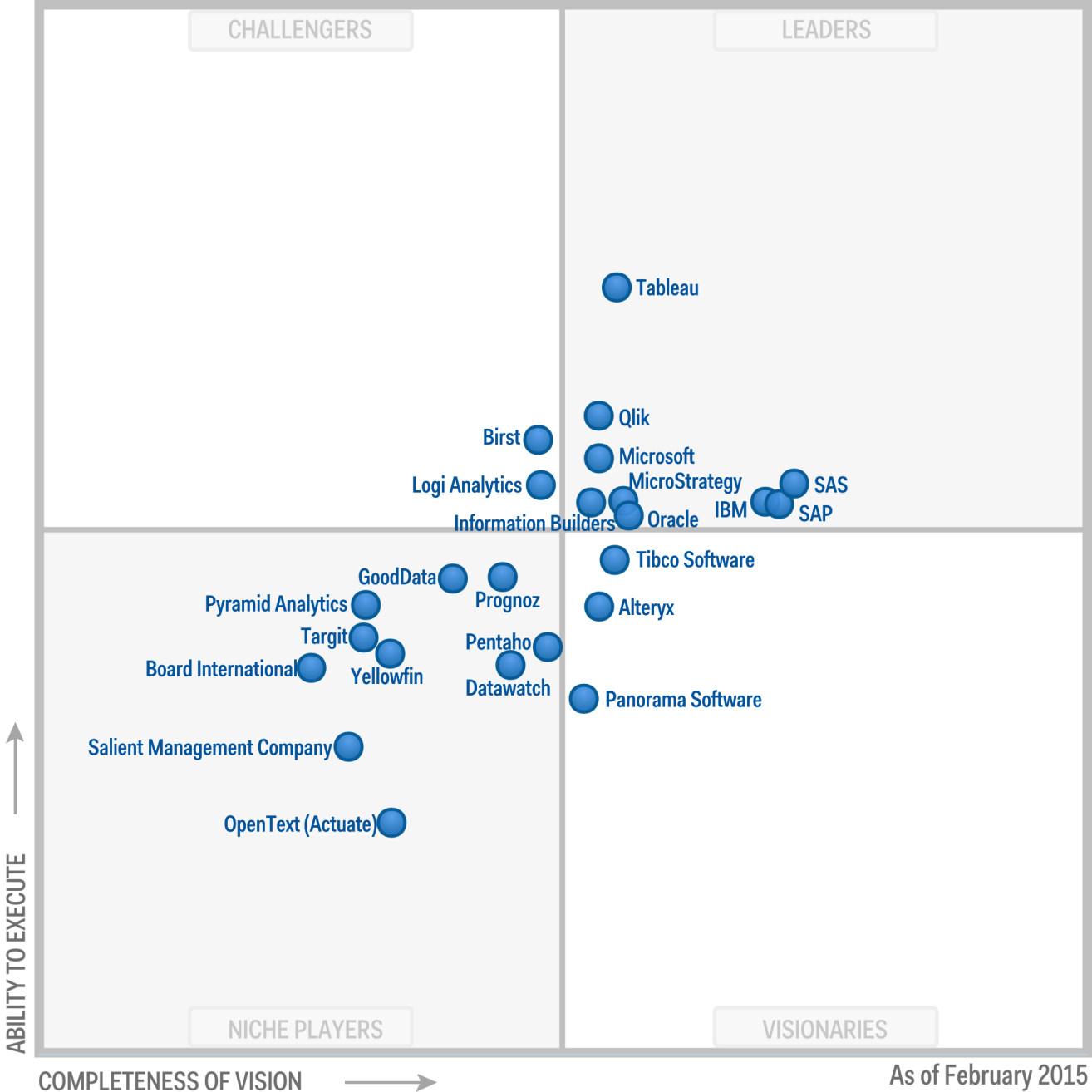
Gartner's infamous Magic Quadrant for Business Intelligence and Analytics Platforms for 2015 has just been released. You can see the quadrant below. We will write about it a little later.

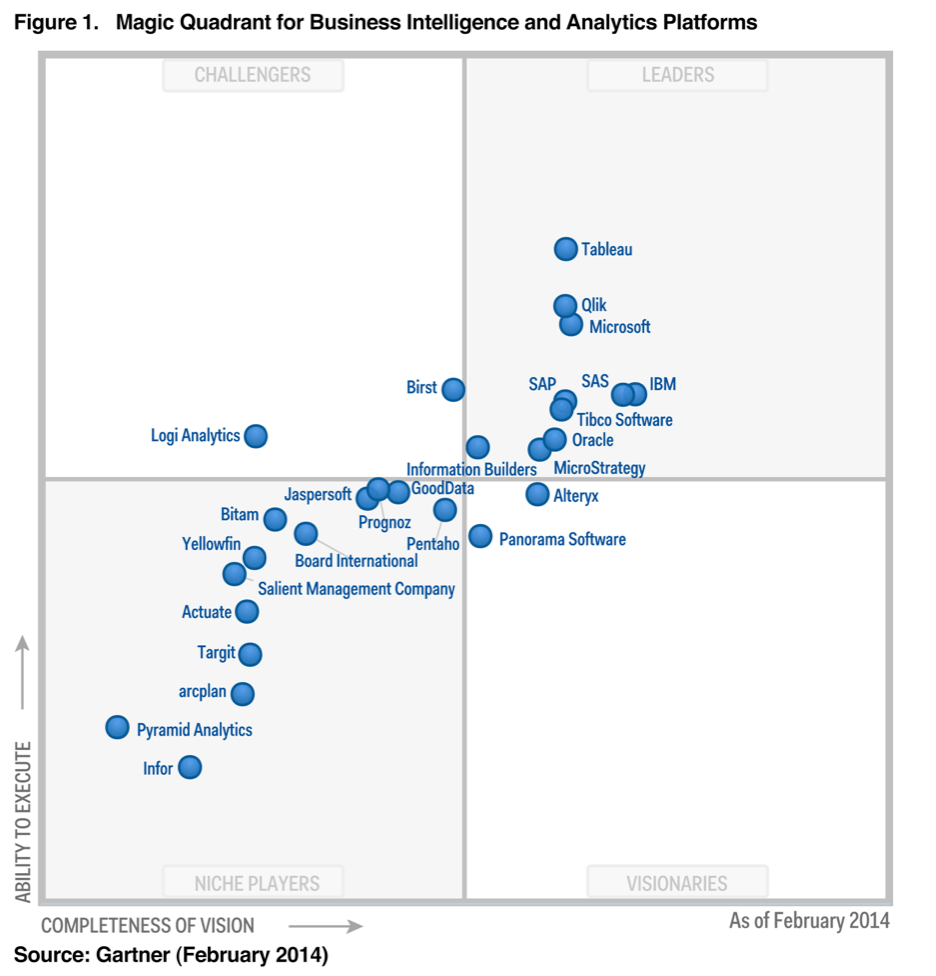
Also compare it with Magic Quadrant of 2014 (see below).

For now some notes :


  • Tableau's stellar rise to leaders quadrant and now becoming the outliner performing better than all others is much more pronounced now in 2015. And this is still before the exiting new release of Version 9. Gartner says "Tableau has clearly defined the market in terms of data discovery, with a focus on "helping people see and understand their data." It is currently the perceived market leader with most vendors viewing Tableau as the competitor they most want to be like and to beat. At a minimum, they want to stop the encroachment of Tableau into their customer accounts."
  • Tibco Software fell from leaders to visionaries. Gartner says "The future of Tibco itself is uncertain, following the acquisition of the company by Vista Equity Partners (which closed in December 2014). In the near term, Tibco will operate as a privately held single entity, as it did when it was publicly traded, but the longer-term intentions of Vista are not yet clear. The ingredients for a leading BI and analytics platform are present with Tibco's many strategic acquisitions; however, Vista will need to implement major changes to address the sales model and execution issues, which have plagued Tibco historically, in order to regain traction and once again be recognized as a market leader."
  • Logi Analytics is moving closer to leaders quadrant. 


Gartner Magic Quadrant for Business Intelligence 2015

Gartner Magic Quadrant for Business Intelligence 2015

Thursday, March 6, 2014

What is QlikView.Next?

Update : After calling it QlikView.Next for a few years, Qlik (formerly known as QlikTech) has changed the name of the new platform to Qlik Sense.

QlikTech has released its last major version upgrade, QlikView 11 almost 3 years ago in November 2011. Since than, there were several service packs and new builts but no new version. And if you are looking forward for QlikView 12, it will never be released. Next version of QlikView will be named QlikView.Next.

According to the information QlikTech has released up to now, QlikView.Next will be fundamentally different than QlikView 11 and its almost identical predecessor QlikView 10. The interactive visualization user experience is completely redesigned in QlikView.Next. QlikTech calls this Natural Analytics which according to them makes it easier for users to discover and share new insights.

Natural Analytics builds on QlikView’s game-changing associative experience and again according to QlikTech incorporates enhanced comparisons, collaboration, workflow, sharing and data dialogs, as well as enhanced insights from unique visualization techniques that Qlik acquired from NComVA in June 2013.

With QlikView.Next, QlikView Server and administration capabilities will also be completely re architectured. QlikView.Next business intelligence software suite will also come with reusable semantic intelligence and modeling that draws on its acquisition of Expressor Software, open APIs for extensibility, expanded data connectivity, and enhanced scalability and security features.

Compared to the offerings of the incumbent IT-centric vendors, QlikView revolutionized business intelligence domain for its ease of use for end users, particularly in terms of its interactive dashboards plus its successful “land-and-expand” strategy. But that was long long time ago. Since 2010 or QlikView 10, QlikTech has released nothing significantly new and also abandoned its land-and-expand strategy by forcing QlikView customers to buy at minimum a QlikView Server instead of desktop licences. And in terms of visual-based interactive exploration and analysis capabilities, user experience, and the time it takes for business users to gain proficiency in authoring, the current QlikView 11.x is more limited compared to offerings from other stand-alone data discovery vendors like Tableau. You can see this in successive Gartner Magic Quadrant for Business Intelligence Reports. In 2012, QlikView was the only “agile” visual discovery platform in “leaders” quadrant among big boys like SAP, Oracle and Microsoft. In 2013, Tableau and Spotfire has entered the “leaders” quadrant and now in the latest 2014 edition, you can see that Tableu is clearly ahead of QlikView in terms of ability to execute and on par with it in its completeness of vision. So while QlikTech was pouring all the cash in its marketing juggernaut, it looks like no fund is left for R&D and QlikView became a little obselete in the past 3 years.

What is QlikView.Next?
And almost 1 year long delay in the release of QlikView.Next, which is seen as QlikView’s answer to Tableu’s rise, does not help. QlikView.Next was expected to be released in 2013 (already breaking QlikView’s product release phase of 1 major release in every year) but we have still not seen it yet (except some marketing mumbo jambo about it). This gap of whole year delay has given other vendors to improve their offerings, close the gap and in some major areas supress what QlikView offers.

Currently (as of 2014), our view is that QlikView is the best data visualization leader, closely followed by QlikView. QlikView may be the top business intelligence platform in 2015 if QlikView.Next becomes a success. But it seems like QlikView guys are also planning to shoot themselves from their feet by discontinuing free QlikView Desktop edition at a time Tableau is planning to release a Mac version of its desktop edition. If QlikView.Next does not take of as Qlik expects and Tableau innovates like this, we are pretty sure that 2014 will be the year when Tableau took over the leadership from QlikView.

There were rumors that QlikView Free Desktop will be removed from Qlikview.Next but according to a press release on 9 April 2014, qlikView will still provide free desktop:

Presenting to over 1200 attendees at its Global Partner Conference, Anthony Deighton, Chief Technology Officer of Qlik (NASDAQ: QLIK), a leader in user-driven Business Intelligence (BI), announced that the Company will release a free desktop version of QlikView.Next via Personal Edition download early in third quarter of 2014. Qlik will also offer a free cloud service for small group sharing of analysis built in this desktop client. Personal Edition business analytics users will be able to leverage QlikView.Next’s intuitive features to build a customized app in minutes by just dragging and dropping, experiencing many of the Natural AnalyticsTM user interface capabilities before the server and enterprise functionality of the complete platform is expected to be generally available in second half of 2014.
Source : Qlik Announces Free QlikView.Next Personal Edition Download Will Be Available to the public early third quarter
Monday, February 24, 2014

Magic Quadrant for Business Intelligence and Analytics Platforms 2014

American information technology research and advisory firm Gartner’s Magic Quadrant for Business Intelligence and Analytics Platforms is a highly respected ranking of Business Intelligence and Analytics players. In Magic Quadrant for Business Intelligence and Analytics Platforms 2014 (you can access full report from here), the leaders quadrant, which houses top players in terms of ability to execute and completeness of vision, is now crowded with Tableau, Qlik (QlikTech which has re-branded itself), Microsoft, SAP, SAS, IBM, Tibco Sportfire, Oracle, Information Builders and Microstrategy.

Tableau, which has entered the leaders quadrant just in 2013, is now the best BI/BA platform in terms of ability to execute, clearly highest scoring leader in terms of ability to execute.

There are two challengers in 2014, Birst and Logi Analytics (formerly LogiXML). Although Logi Analytics seem to go down in both ability to execute and completeness of vision, Birst is now almost in the leader’s quadrant.

Each year, Gartner analyzes every vendor in the Business Intelligence and Analytics market. Their research has particular significance because it often identifies the innovations that drive the market. As part of that report, Gartner also releases the Magic Quadrant, which shows the relative positions of the market’s competitors. The trends and innovations that Gartner has identified this year are familiar ones.

Gartner Magic Quadrant for Business Intelligence and Analytics Platforms 2014
Tableau’s popularity is reflected in its Wall Street highflyer profile. Tableau’s year-over-year revenue growth has spiraled upward 62%, 71%, 90% and 95% in the last four quarters.

Here is a summary of what happens in Business Intelligence platform domain based on Gartner’s report:

The broad shift to the left is tied to the years-long ascendance of data-discovery platforms from the likes of Tableau Software, QlikTech, and Tibco Spotfire. Data discovery is now driving the majority of new software license revenue, but these platforms tend to lack “the necessary features in relation to governance, administration, and scalability,” Gartner reports. 
Meanwhile, incumbents like IBM, SAP, Oracle, and MicroStrategy that tend to do well on governance, administration, and scalability have had “limited success in delivering ‘good enough’ data discovery capabilities,” Gartner writes. In other words, practitioners want and need the ease and speed of data-discovery platforms, but they shouldn’t have to give up admin control and the assurance of data-modeling and data-quality consistency across high-scale deployments.
Source : Gartner BI Magic Quadrant: Winners & Losers